10 Prime Cities to Open a Childcare Franchise
Discover the top 10 U.S. cities to open a childcare franchise in 2026, focusing on growth potential and demand for quality early education services...
7 min read

Understanding the pros and cons of a childcare franchise is an important first step for entrepreneurs exploring opportunities in this essential and growing industry.
The childcare industry continues to be one of the most resilient sectors in the U.S. economy (Grand View Research, August 2025). With more dual-income households than ever and an increasing emphasis on early childhood education, demand for high-quality childcare remains strong (Institute for Family Studies, 2024).
But opportunity alone isn’t enough. Owning a childcare franchise requires significant investment, operational commitment, and the right strategic fit.
Before you move forward, it’s essential to understand the pros and cons so you can confidently decide if investing in a preschool franchise is right for you.
A childcare franchise is a business model that allows you to own and operate an early education center under an established brand, using its proven systems, curriculum, and operational support. Instead of starting from scratch, you step into a structured model designed to simplify setup and day-to-day management.
In this model, franchise owners pay an initial franchise fee along with ongoing royalties and marketing contributions in exchange for access to the brand and its systems.
For many entrepreneurs, this approach reduces uncertainty and makes it easier to get up and running with a strong foundation already in place.
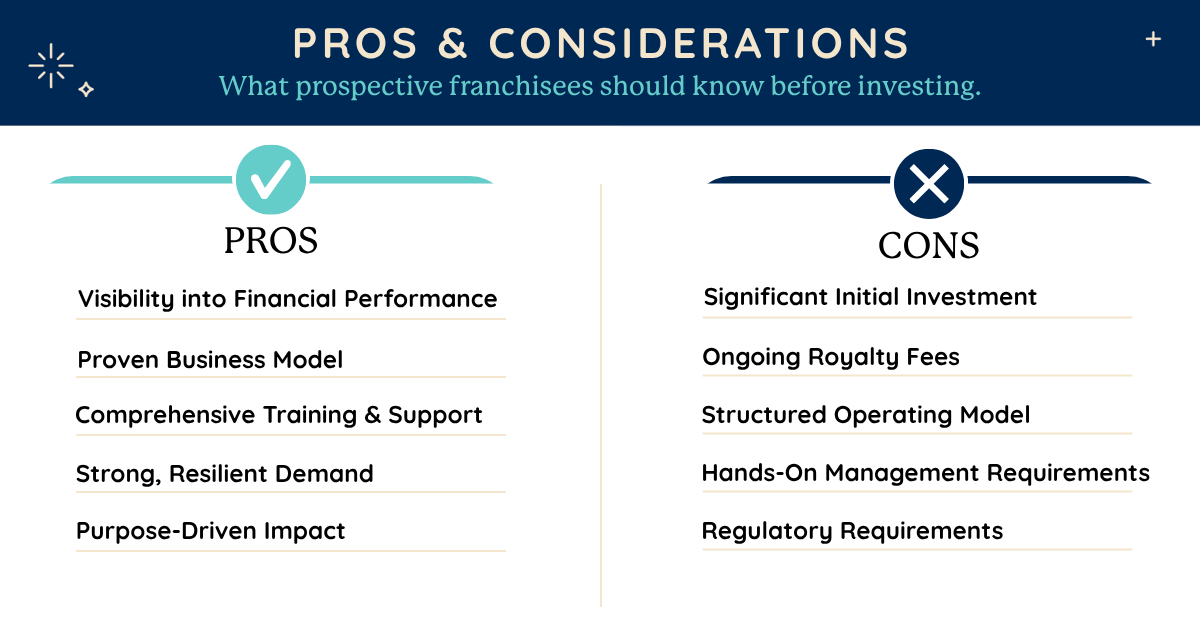
Owning a childcare franchise offers several compelling benefits for prospective business owners looking to enter a high-demand, purpose-driven industry.
While childcare franchising offers meaningful advantages, there are important considerations to evaluate before making an investment decision.
Below, we will take a deeper dive into each of these pros and cons to help you decide if owning a childcare franchise is right for you.
Established childcare franchise systems often provide insight into financial performance through key metrics such as average unit volume (AUV) and earnings before interest, taxes, depreciation, and amortization (EBITDA).
These benchmarks, typically outlined in Item 19 of their Franchise Disclosure Document (FDD), help prospective owners better understand cost structure, operating expectations, and how centers may perform over time.
For example, let’s take a look at some of the key financial numbers from The Goddard School’s most recent FDD. In 2025, mature schools* reported:
*Based on mature school performance (open 18+ months). You should refer to Item 19 of Goddard Franchisor, LLC’s 2026 Franchise Disclosure Document for more information regarding the reported earnings of Goddard School franchises. Your individual results may differ. There is no assurance that you will earn as much as the amounts reported by Goddard School franchisees.
This demand, combined with structured systems and support, allows franchise models to scale while maintaining operational consistency across multiple locations.
Download the 2026 Goddard Franchisor LLC Franchise Disclosure Document.
One of the key advantages of owning a childcare franchise is the ability to operate under an established brand that many families already recognize and trust. In a service-driven industry like early childhood education, trust plays a critical role in enrollment decisions, and brand reputation can significantly influence how quickly a new location gains traction in its community.
Established childcare franchises build this trust over time through consistent delivery of high-quality programs, clear educational standards, and strong relationships with families. This consistency can help set expectations for parents and create a sense of reliability that independent centers often need years to develop.
For example, at The Goddard School, this brand strength is supported by more than 38 years of experience in early childhood education and a network of over 665 schools nationwide.
This scale, combined with a focus on delivering a consistent educational experience, helps franchise locations enter the market with a recognizable identity and an established reputation.
One of the key advantages of childcare franchising is the level of structured training and support provided throughout the ownership journey. Rather than building a business independently, franchisees operate within an established system designed to guide them from initial development through day-to-day operations.
Support typically spans critical areas such as site selection, construction, financing, health and safety, educational programs, marketing, and ongoing operations, helping create a more predictable path to opening and long-term growth. For many owners, especially those new to business ownership or early childhood education, this structure can simplify decision-making and reduce early-stage uncertainty.
For example, at The Goddard School, this support is delivered through dedicated teams and established processes that assist franchisees at every stage. From development to launch, support includes:
While offerings and performance can vary widely across franchise systems, many established brands provide similar forms of support and operational structure.
Childcare is a high-demand, non-discretionary service driven by the needs of working families. As dual-income households continue to rise, reliable childcare has become essential, making the industry largely recession-resilient, with demand remaining steady even during economic shifts.
Demand is further supported by increased focus on early childhood education and a nationwide shortage of available childcare. Together, these factors create a stable, long-term demand profile and ongoing need for new, high-quality centers.
Owning a childcare franchise offers more than financial potential. It creates an opportunity to build a business that makes a meaningful and lasting impact on children, families, and the broader community. Early childhood is one of the most important stages of development, and high-quality education during these years can shape long-term academic, social, and emotional outcomes.
Many entrepreneurs are drawn to this space because it combines business ownership with the ability to make a real difference. Whether coming from corporate, education, or entirely different backgrounds, owners often share a common goal: to create value that extends beyond the business itself.
That impact is reflected in the day-to-day experience of operating a childcare center, including the ability to:
Ultimately, childcare ownership offers something unique: the ability to build and grow a business while making a measurable difference in people’s lives every day.
Starting a childcare franchise requires a substantial upfront investment, including real estate or lease costs, construction, licensing, and initial operating expenses. This reflects the complexity of developing a high-quality early education center that meets both operational and regulatory standards.
At The Goddard School, for example, franchisees must meet specific financial qualifications as well as overall investment requirements. These include:
Estimated initial investment ranges:
Because every market and site is different, total investment can vary. More detailed cost breakdowns are available in Item 7 of The Goddard School’s 2026 Franchise Disclosure Document (FDD).
In addition to the initial investment, childcare franchise owners typically pay ongoing fees, such as royalties and marketing contributions, as part of the franchise model. These fees are a standard component of franchising and are used to support the broader system behind the brand.
While ongoing fees do impact overall margins, they also provide continued access to resources that help support day-to-day operations and long-term growth. This often includes marketing initiatives, brand development, operational systems, educational programming, and ongoing training.
For many owners, these contributions help maintain consistency across locations and ensure the business benefits from continued improvements to the overall franchise system.
Childcare franchises operate within a structured system that includes defined standards for curriculum, operations, and overall brand experience. While this framework may limit certain areas of flexibility, it plays an important role in providing clarity and consistency for owners.
These established guidelines help ensure that each location delivers a reliable, high-quality experience for families, which is especially important in a trust-driven industry like early childhood education. A consistent approach across locations also strengthens brand reputation and helps set clear expectations for both staff and families.
For many owners, this structure reduces decision fatigue and provides clarity on how to operate within the franchise model.
Owning and operating a childcare center requires active involvement in areas like staffing, operations, and oversight, especially in the early stages when building enrollment, establishing your team, and developing a strong presence in the community.
For many owners, responsibilities often include managing staff, overseeing daily operations, engaging with families, and supporting business growth efforts such as tours and enrollment. While the level of involvement can evolve over time, particularly for multi-unit owners, most models are designed around engaged ownership to maintain quality and consistency.
While this can be demanding, it also allows owners to stay closely connected to their business and play a direct role in shaping its culture and impact.
For a deeper look at what daily ownership can look like in practice, you can explore Goddard School franchisee experiences and schedules in this article.
Childcare centers operate within a highly regulated environment, with strict requirements around licensing, safety, staffing ratios, and educational standards. These regulations vary by state and require ongoing compliance, including inspections and administrative oversight.
While navigating these requirements can be complex, they play an essential role in maintaining quality, safety, and trust across the industry. For franchise owners, this structure helps ensure that centers consistently meet established standards, providing families with confidence in the care and education their children receive.
Owning a childcare franchise can be both a rewarding and complex opportunity. While the industry offers strong demand, structured support, and the ability to make a meaningful impact, it also requires a significant financial investment and ongoing operational involvement.
This path is often a strong fit for individuals who are looking for a hands-on business, value working within an established system, and are motivated by both financial and community impact. Many owners come from a wide range of professional backgrounds but share a willingness to commit time, resources, and leadership to building their business.
At the same time, it may be less aligned for those seeking a passive investment or a high degree of operational flexibility. Understanding your goals, available capital, and preferred level of involvement is key to determining whether this opportunity is the right fit.
We hope this article gives you more insight into the pros and cons of owning a childcare franchise.
If you’re exploring how The Goddard School stands out as a franchise where purpose and performance can go hand in hand, these resources can help you take the next step:
If you’re ready to take the next step in your franchising journey, submit your information and a member of our team will be in touch.

Discover the top 10 U.S. cities to open a childcare franchise in 2026, focusing on growth potential and demand for quality early education services...

Are you interested in learning more about the best childcare franchise opportunities this year? Investing in a childcare franchise offers a unique...

Learn about the process of opening a Goddard School Franchise. Review the steps, requirements, and support available to prospective franchisees...